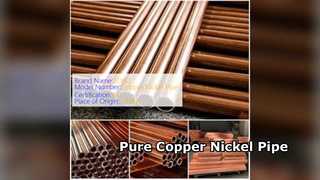
Brief: In this video, we provide a guided demonstration of high-standard copper-nickel tubing, showcasing its manufacturing precision with a tolerance of ±0.1mm and customizable outer diameters. You'll see how these tubes are produced to meet international standards like ASTM B111 and B466, and learn about their applications in marine, oil and gas, and power generation industries. Watch to understand the quality control processes and versatile uses of this durable alloy tubing.
Related Product Features:
Manufactured with high precision tolerance of ±0.1mm for consistent quality.
Customizable outer diameter and wall thickness to meet specific project requirements.
Excellent corrosion resistance suitable for marine and harsh industrial environments.
Superior thermal conductivity ideal for heat exchangers and condensers.
High tensile strength to withstand extreme pressure and temperature conditions.
Available in various surface treatments including polished, brushed, and anodized finishes.
Versatile applications across marine, oil and gas, chemical, and power generation industries.
Certified to ISO, ASTM, and DIN standards ensuring quality and reliability.
Faqs:
What standards does your copper-nickel tubing comply with?
Our copper-nickel tubing is manufactured according to ASTM B111, B466, B467, B468, B469 standards and certified with ISO 9001, ISO 14001, OHSAS 18001, PED, and RoHS certifications.
What customization options are available for the copper-nickel tubing?
We offer customized outer diameter, wall thickness, length, and surface treatments including polished, brushed, and anodized finishes to meet specific project requirements.
What is the delivery time and minimum order quantity for copper-nickel tubing?
The delivery time is 15 workdays with a minimum order quantity of just 1 piece, making it accessible for both small and large-scale projects.
What industries commonly use copper-nickel tubing?
Copper-nickel tubing is widely used in marine applications, oil and gas pipelines, chemical processing plants, and power generation systems due to its corrosion resistance and thermal conductivity.